
Vertical-drama studios and solo creators
One idea in.
A finished film out.
Most tools generate a shot. A shot is not a film. Octoryn Studio builds the factory around it: outline, script, storyboard, voice, lip-sync, edit, master. Four lines, eleven stages, run back to back. Wherever it goes wrong is where you stop it.
Free plan: unlimited drafts plus roughly one real render. Enough to take one project the whole way down the line and judge it yourself.
Straight off the line
One shot, rendered by the line
Eight seconds, one shot, no cut. A storyboard description goes in, footage comes out, and the badge in the corner was burned in by the line — not added for this page. Only one shot here, because right now only half of this line runs on real models.
Project briefA night-shift clerk notices that the customer who walks in at 3 a.m. every night never appears on the security footage.
Where this shot came from
- Format
- Commercial · vertical 9:16
- Shot length
- 8.0 s
- Picture
- xAI · Grok Imagine
- Framing
- Vertical, subject fills the frame
- Badge
- Burned in by the line
- Grade
- None — raw output
- Why one shot and not the whole cut: screenwriting goes through octoryn-router, and that credential is not wired up yet. So the lines in a full render are still stitched by the built-in writer — all four beats recite the same brief. The picture holds up; the words do not. Better to show you only the half that does.
- The picture came from xAI, at final grade against live credentials. The public environment has no provider keys injected, so what you get on signup is draft grade: structure, pacing and timeline are all real, the picture is a concept board.
- Muted by default. Turn the sound on in the player if you want it.
The line
What sits between a sentence and a film
You only ever write in plain language: an idea, a few lines of dialogue, a shot description. How the prompt gets phrased, which vendor takes this shot, how the reference image is fed in — that is the line's own business. It should never have become your homework.
How it works
An assembly line you can stop mid-run
Here, one-click means eleven stages running back to back. It does not mean welding them into a black box. Whichever stage is wrong is the one you stop at. Re-run it, and nothing above it moves.
Learn moreChange a line, re-render one shot
Episode three, shot seven. You want that line said differently. Fix it, press run, and one shot renders again. The outline, the episode split and the cast sheet are not touched.
The console says what it is doing
Which stage is running, how long it has taken, which vendor took it, why it failed. All of it on the surface. An error is not the vendor's raw text thrown over the wall: it says what went wrong and what to do next.
It quotes the step before it spends anything
The estimate and the actual charge read the same rate table, so the estimate cannot be quietly optimistic. If your balance is short you are stopped at the door, not at shot eight.
One vendor fails, the next one takes it
Rate limits and content refusals are usually one vendor having a bad day, and switching often just works. Only when every candidate has failed does it drop to the built-in preview. You do not leave empty-handed.
Six formats
You pick what you are making, not a screen of parameters
Aspect, length, shot density, story structure, whether there is dialogue or a score. Picking the format changes how the entire line behaves, and you never once see the phrase “shot duration range”.
All six formatsVertical drama
Serialised, vertical, one hook per episode.
Cinematic short
Widescreen, three acts, image over talk.
Music video
Cut to the track. The picture serves the song.
Short film
One complete small story, three to five minutes.
Ad spot
Fifteen to thirty seconds. Say one thing properly.
Explainer
Narration-led. Make one thing clear.
Why it is built this way
Three decisions we made on purpose
Nothing is locked
Eleven stages, every one of them stoppable
The storyboard comes back and shot five is blocked wrong. Rewrite that shot, re-run that step. No other shot is rendered again, and the outline and script above it do not move. A first-timer confirms their way to the end; someone who knows what they want stops wherever they like. Same path, not a second interface.
Version five is on us
Drafts are free. You pay for the master
Nobody gets the storyboard right first time. Version two moves the opening, version three merges two shots, version four puts them back. All of it runs as a draft: structure, pacing, voice and subtitles are real, the picture is a concept board, it renders in seconds and burns no quota. Pay when you are happy.
No vendor is load-bearing
Shots inside one episode go to different vendors
One carries a reference image, one runs two seconds, one has to match an end frame. Every shot asks for something different, so every render picks again. We buy direct. No aggregators: they mark up the vendor's own price. And no reselling someone else's packaged product, because that product is already aggregating and you would be paying two margins. Five vendors are wired into the catalogue. Adding a sixth is two methods, one catalogue entry and a set of contract tests.
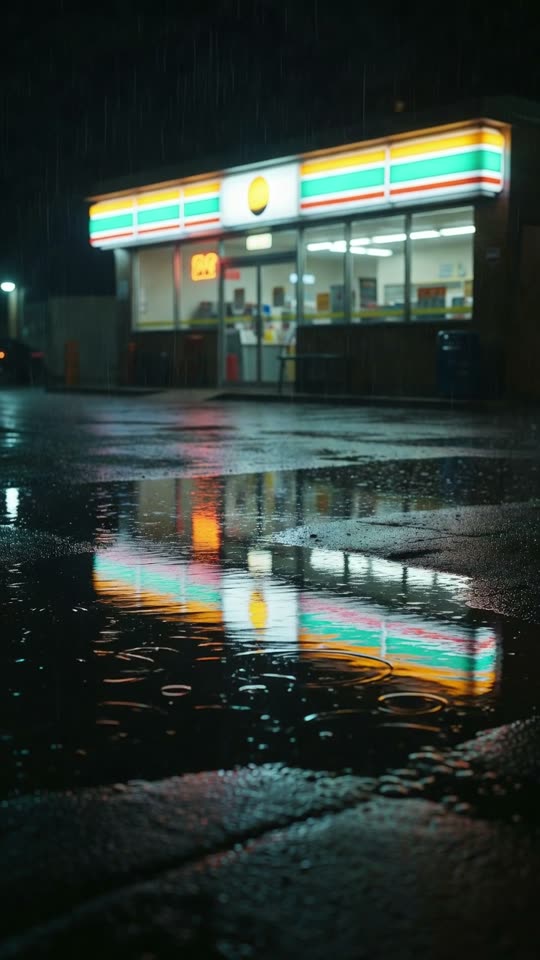
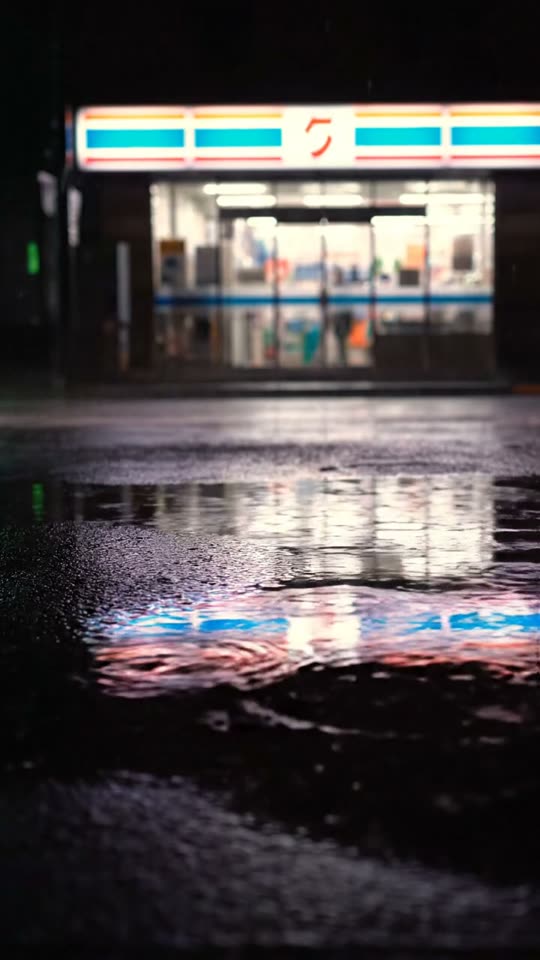
The product
This is the workbench
Real screenshots. Not mock-ups.
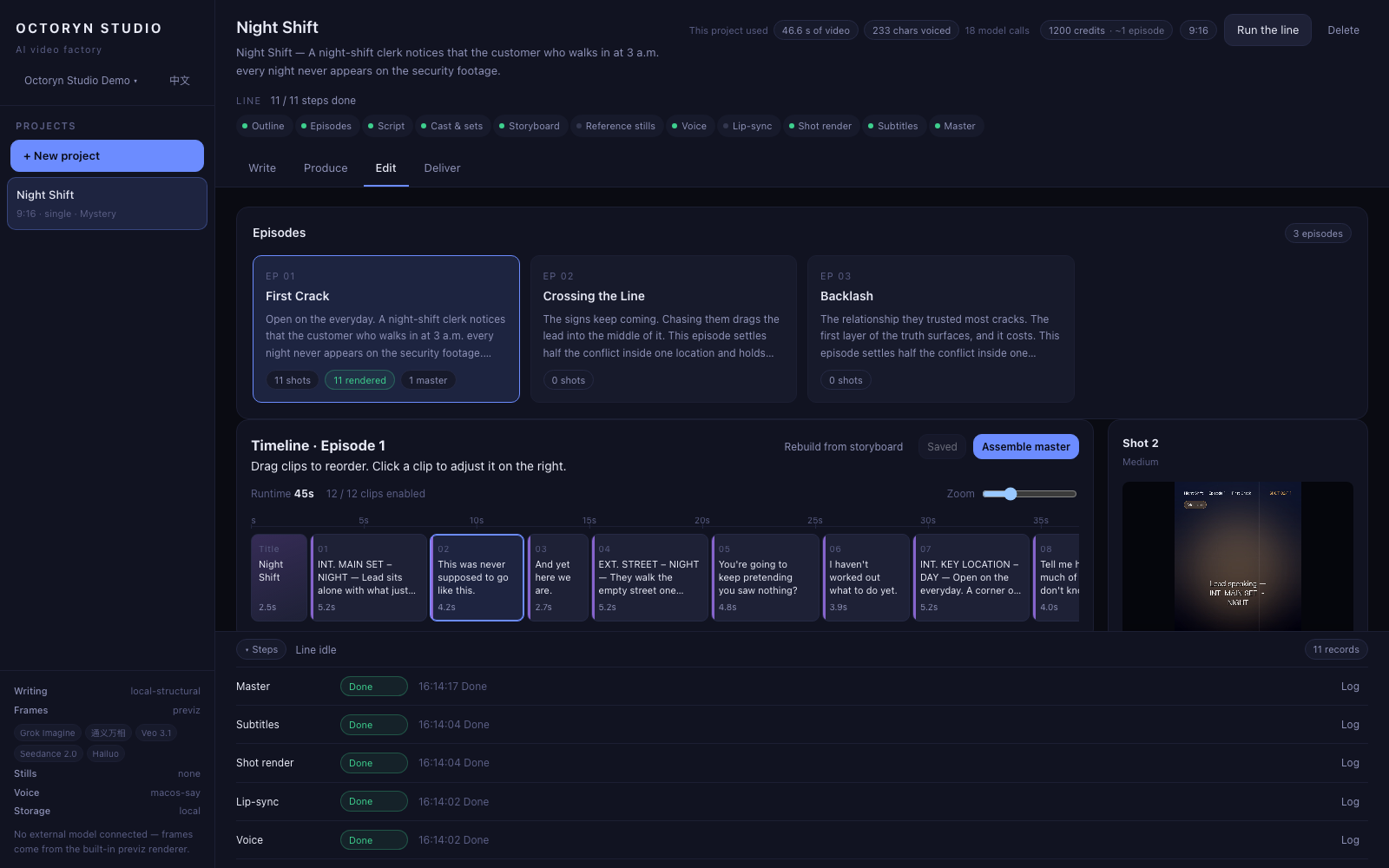

These are captures of one real run all the way down the line: the project, script, shots and timeline were all produced by the product itself. That run was in draft grade, so the footage inside the captures is the built-in preview's concept board. The finished film on this site came off a separate, final-grade run and is posted exactly as it rendered — we are not padding the page with somebody else's work, and we are not passing a concept board off as a master.
Model scoring
We rank models on our own production data, not their benchmarks
A vendor benchmark is the vendor setting its own exam and marking its own paper. It has nothing to do with the work in front of you. We count one thing: what that vendor actually delivered to a user on our line. Four signals, weighted like this.
How the score is computed, and the five rules it cannot bendPricing
The quota is counted in episodes, because episodes are what you make
Drafts are unlimited and burn no quota on every plan. The only thing that actually costs you anything is the final render.
See pricingTake one project the whole way down the line once, then decide whether it is worth it. Drafts stay unlimited.
Start freeOne person, one whole line. This is the tier where a character stays the same person from shot to shot.
Choose thisOne drama line's normal output, with the asset library shared so anyone picking it up gets the same cast.
Choose thisSeveral lines running at once, and the line itself wired into your own systems.
Choose thisAI disclosure
Every master carries an AI-generated badge by default
It is a badge in the lower-right of the picture, not a boolean in the metadata. Turning it off is your compliance decision, not a default we made on your behalf.
Questions
What you probably want to know first
Do I need to understand prompting or models?
How long does an episode take?
Can I fix one shot without re-rendering the film?
Is the footage from your own models?
What happens if a model vendor goes down?
Are subtitles burned in or a separate file?
Run one episode and see
Sign up and go; drafts are unlimited. A full pass down the line takes a few minutes, and at the end of it you are holding a film you can send to someone.